
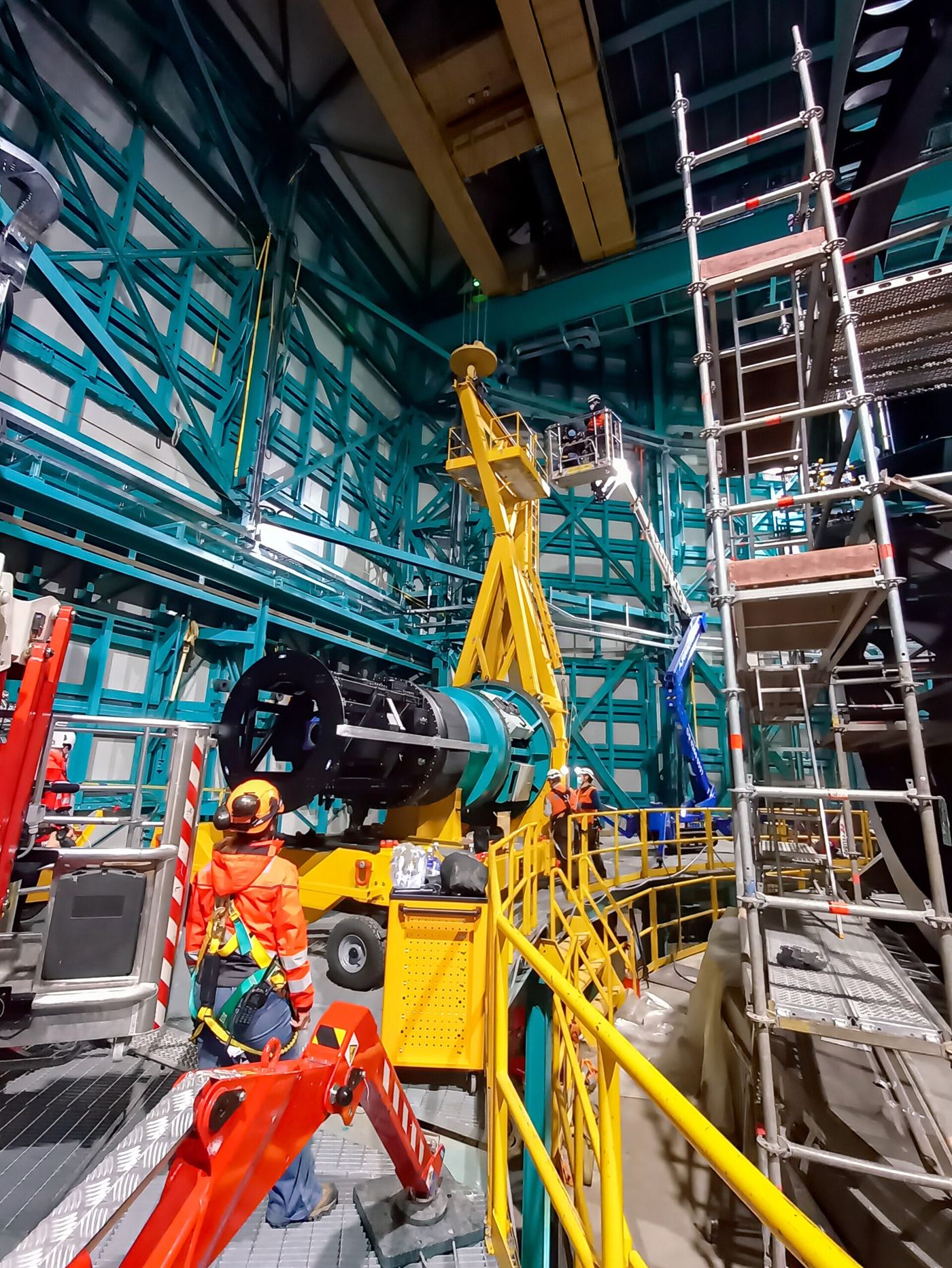
On a mountaintop in Chile, the largest digital camera ever built is filming the sky. The Vera C. Rubin Observatory released its first images on 23 June 2025, and they showed what a decade of patient watching will look like: a single view of the Trifid and Lagoon nebulae contained millions of stars and galaxies, and in just ten hours of test observations the telescope spotted 2,104 asteroids that had never been seen before. The observatory’s 8.4-metre telescope carries a 3.2-gigapixel camera, roughly the size of a small car, and it will photograph the entire southern sky every few nights for ten years. The project, called the Legacy Survey of Space and Time, began its ten-year run in June 2026, and it is expected to collect about 20 terabytes of data every night. Named after the astronomer Vera Rubin, whose work provided the first strong evidence for dark matter, the observatory is a joint project of the US National Science Foundation and the Department of Energy.
What the Evidence Shows
The point of photographing the same sky again and again is change. Most telescopes take a snapshot; Rubin makes a film. Anything that moves, brightens, fades or explodes will be caught, from asteroids drifting near Earth to supernovae flaring in distant galaxies, and alerts will go out to astronomers around the world within minutes. Over ten years the survey should catalogue billions of galaxies and tens of millions of stars, giving scientists the data to map dark matter, trace how the universe’s expansion is accelerating and work out how the Milky Way was assembled from smaller galaxies. The data will be public, so researchers far beyond the observatory’s own team can mine it for discoveries nobody has planned yet. The first images were only a taste, but they already proved the optics, the camera and the alert system all work as designed. Reporting and analysis from sources such as NASA track the same developments, and specialists following Vera Rubin Observatory sky survey say the direction is now consistent across independent lines of evidence.
The Wider Context
Funding bodies are watching Vera Rubin Observatory sky survey closely because the work sits at the junction of basic curiosity and practical return. Grant panels increasingly ask for a path from discovery to application, while researchers push back that the most valuable uses of fundamental science are rarely the ones written into the original proposal. The tension is productive when both sides stay honest about timescales.
What Happens Next
The long view on Vera Rubin Observatory sky survey is that fields advance by accumulation rather than by single announcements. This result adds a solid, checkable piece to a structure many teams are building, and its authors have shared their data so the piece can be tested from every side. That is how the picture eventually becomes reliable enough to act on. You can follow related developments in our coverage of science.
It is also worth remembering how quickly the picture in this area has changed before. Positions that looked settled a few years ago have been revised as new data arrived, and the same humility is appropriate now. The strongest coverage of this subject, and the most useful advice, tends to come from sources that update their views openly when the facts move, rather than defending an earlier position long after it has stopped fitting the evidence available.
